↑
Skip to Content

Odoo for eCommerce, retail, and wholesale


Connect your online store, retail locations, and wholesale sales in one integrated system. Manage products and variants, customer price lists, B2B and B2C orders, POS, inventory, purchasing, delivery, returns, invoices, and payments without duplicate data entry.


For eCommerce, retail, and wholesale


Connect your online store, retail locations, and wholesale sales in one integrated system. Manage products and variants, customer price lists, B2B and B2C orders, POS, inventory, purchasing, delivery, returns, invoices, and payments without duplicate data entry.

One system for sales across every channel

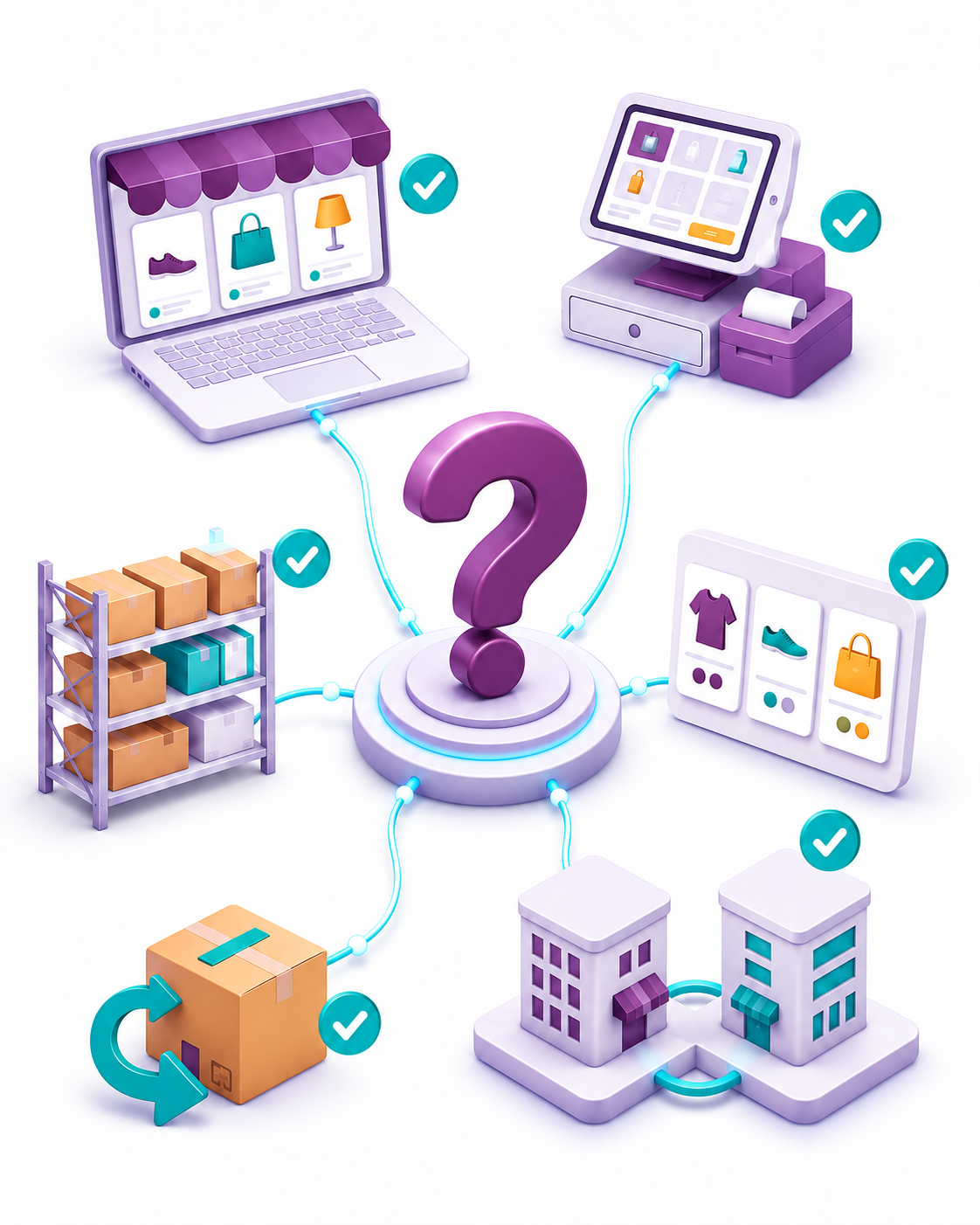
Trading companies take online orders, serve retail customers, work with wholesale clients, purchase goods, and manage stock across multiple warehouses. When each channel uses a separate system, keeping prices, availability, and transaction history consistent becomes harder.

Odoo connects commerce processes through integrated apps. Website and eCommerce support your online store, Point of Sale handles retail sales, CRM and Sales support B2B opportunities and orders, Purchase and Inventory handle purchasing and stock, and Accounting or Invoicing manage invoices, payments, and financial documents.

Product catalogs, customers, and inventory data can be shared across sales channels. Price lists, warehouses, delivery methods, payment providers, and document rules are configured for the specific business model.

Support for POS hardware, fiscal requirements, payment systems, and delivery services depends on the country, installed localization, and integrations in use.

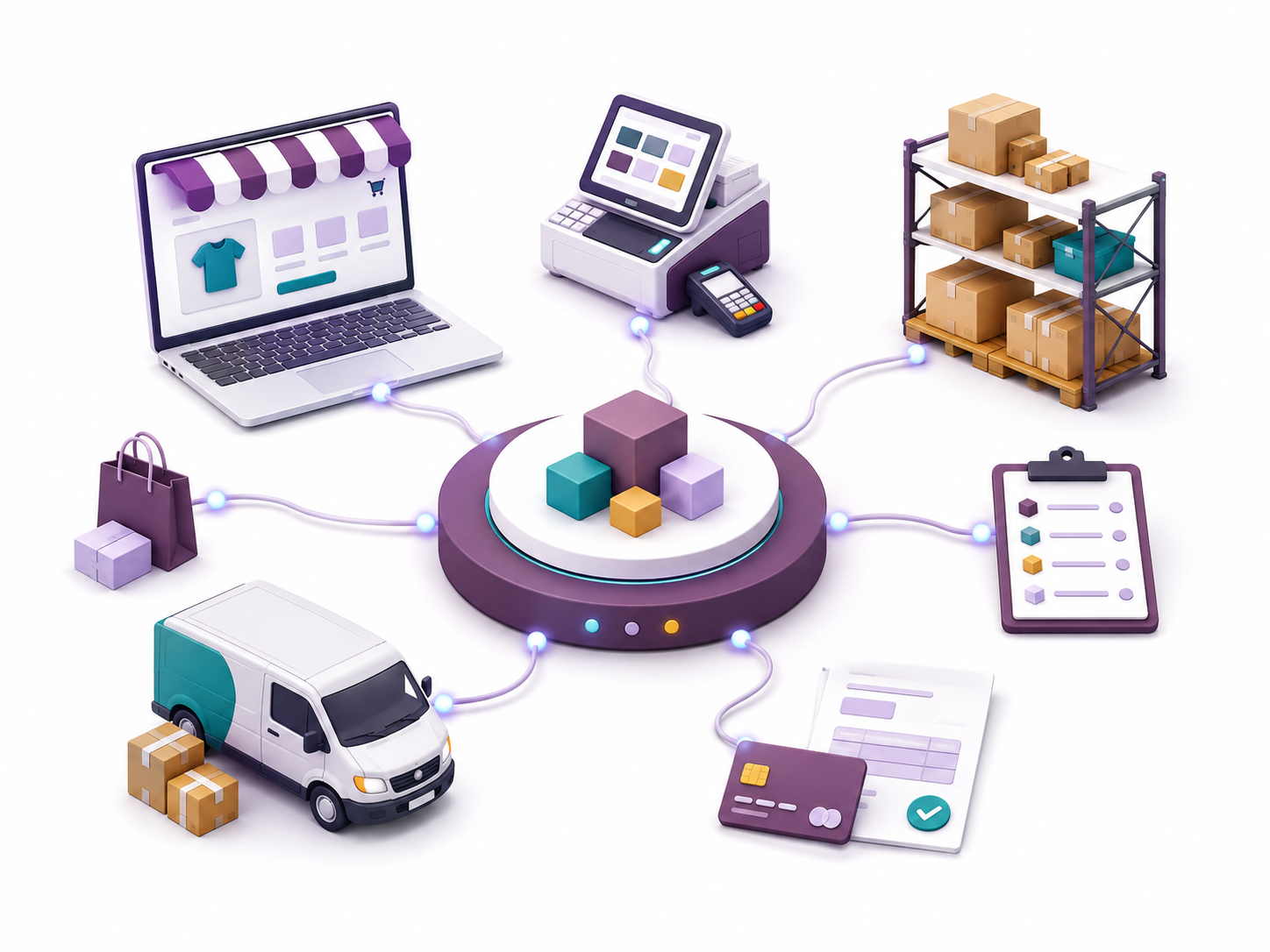
One system for sales across every channel

Trading companies take online orders, serve retail customers, work with wholesale clients, purchase goods, and manage stock across multiple warehouses. When each channel uses a separate system, keeping prices, availability, and transaction history consistent becomes harder.

Odoo connects commerce processes through integrated apps. Website and eCommerce support your online store, Point of Sale - handles retail sales, CRM and Sales - support B2B opportunities and orders, Purchase and Inventory - handle purchasing and stock, and Accounting or Invoicing - manage invoices, payments, and financial documents.

Product catalogs, customers, and inventory data can be shared across sales channels. Price lists, warehouses, delivery methods, payment providers, and document rules are configured for the specific business model.

Support for POS hardware, fiscal requirements, payment systems, and delivery services depends on the country, installed localization, and integrations in use.


Which processes Odoo supports

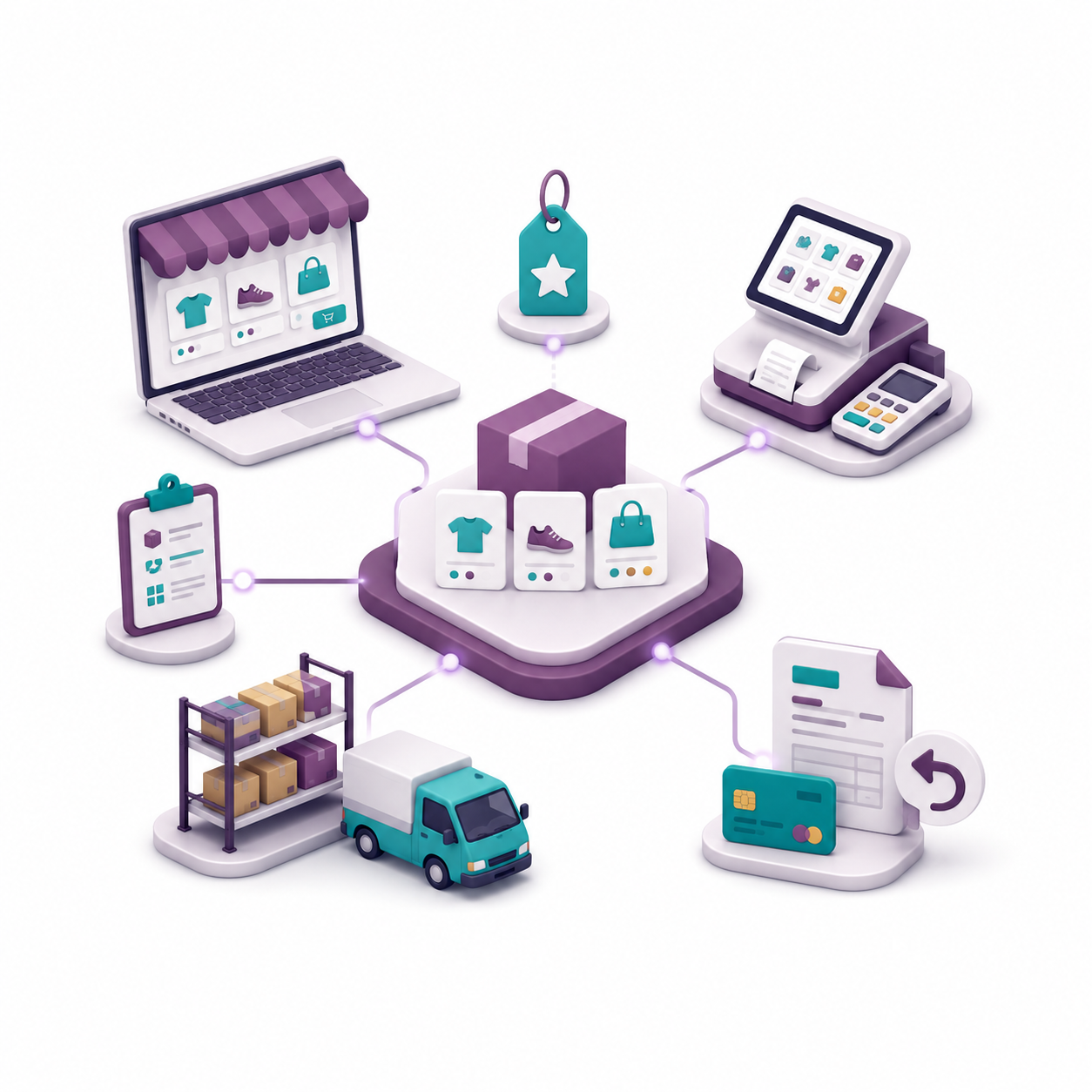
Odoo brings together the online store, retail locations, wholesale sales, purchasing, warehouses, delivery, and financial documents.


Product records store names, descriptions, images, prices, taxes, units of measure, and inventory settings. Variants represent sizes, colors, configurations, and other attributes. Each variant can have its own SKU, barcode, and stock balance.

In eCommerce, customers browse the catalog, select variants, add items to the cart, and complete checkout. Available payment and delivery methods depend on the website, country, and connected providers.

After order confirmation, data flows into sales and, for stock products, supports the relevant stock operation.

Point of Sale lets cashiers select or scan products, identify customers, apply available prices and discounts, take payments, and issue receipts. Sales are saved in POS order history.

The impact on stock, POS sessions, and accounting depends on POS settings, products, payment methods, and accounting journals.

Wholesale inquiries can be recorded in CRM as leads or opportunities. Once terms are agreed, Sales creates a quotation with products, quantities, prices, taxes, deadlines, and payment terms.

Confirmed quotations become sales orders and can link to stock deliveries and subsequent invoices.

Price lists set terms by retail or wholesale customer, currency, validity, and order volume. eCommerce, Sales, and POS can use separate pricing rules.

Discounts, coupons, gift cards, and loyalty programs depend on configuration and sales channel.

Purchase creates requests for quotation and purchase orders, specifying the vendor, products, prices, quantities, and expected delivery dates.

Replenishment can be initiated by an employee or configured rules. Actual quantities are confirmed in Inventory at receipt.

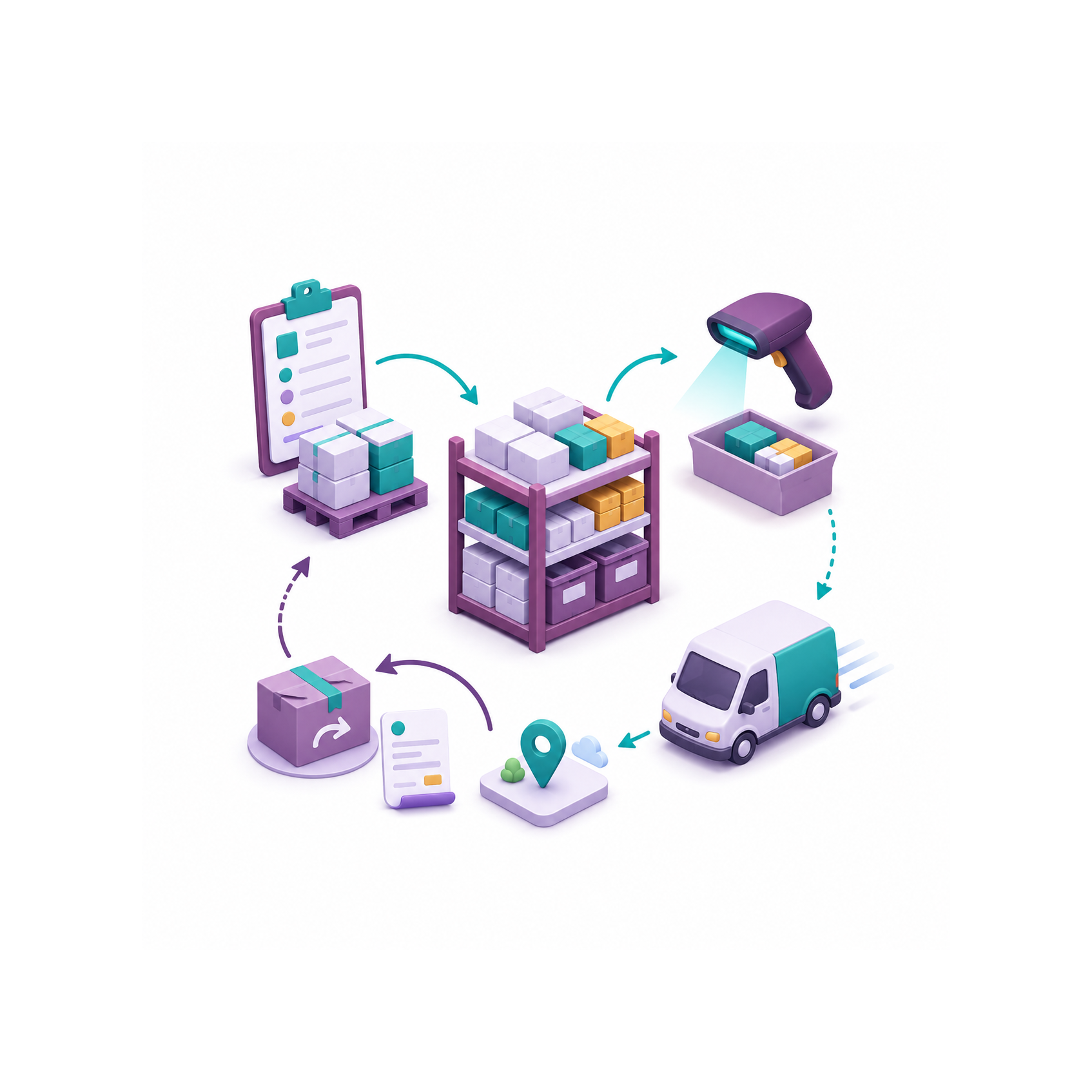
Inventory manages warehouses, locations, stock levels, receipts, internal transfers, and deliveries. Order processing can follow one or multiple stages, depending on warehouse organization.

Barcode validates warehouse operations with a scanner. Shipping costs and methods can be calculated through configured delivery methods and available carrier integrations.

Stock returns can be created from completed deliveries. In POS, returns start from order history. After inspection, the required inventory and financial operations are processed.

If the sale has already been invoiced, adjustments follow accounting rules and the applicable localization. Refund and credit note processing depends on the original payment method and financial document status.


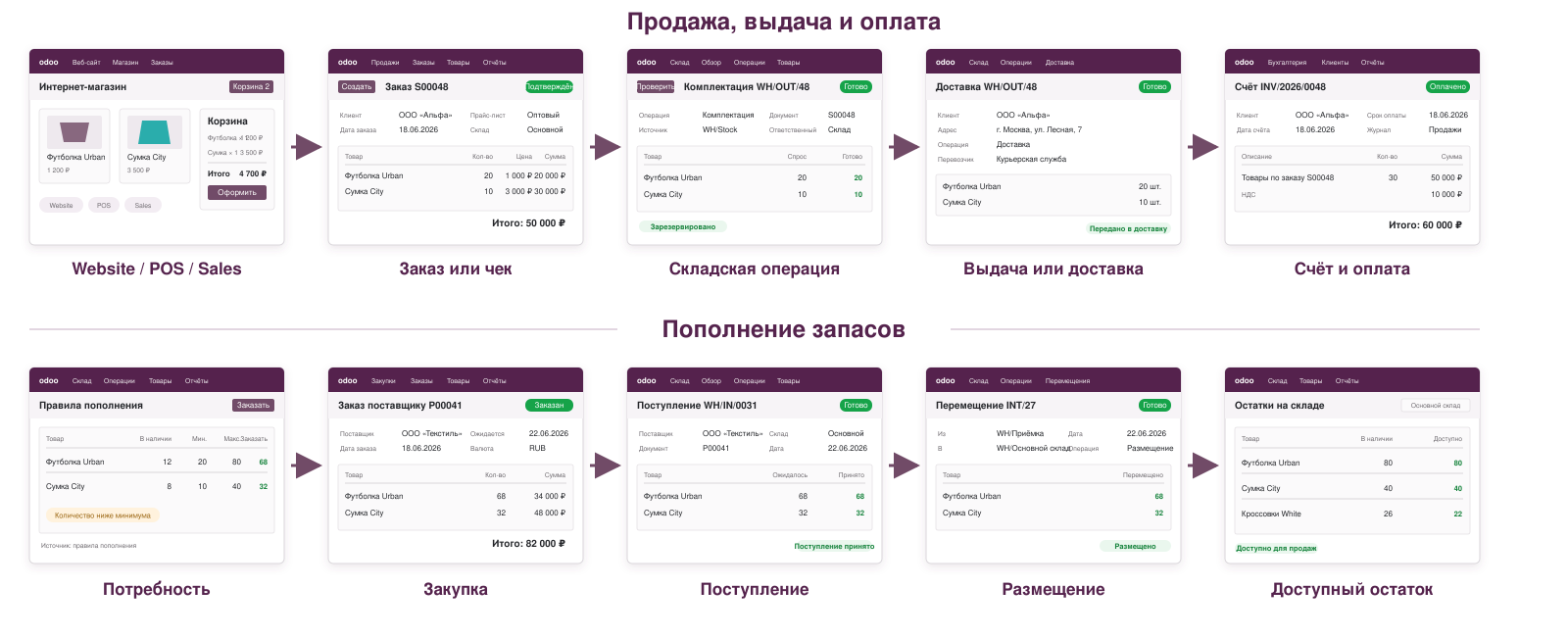
Two end-to-end processes in one system

Product, customer, order, and inventory data is shared across Odoo's sales, inventory, and financial apps.

Two end-to-end processes in one system

Product, customer, order, and inventory data is shared across Odoo's sales, inventory, and financial apps.


 Sales, handover, and payment


The online store creates online orders, POS records retail sales, and Sales handles quotations and wholesale orders. Subsequent inventory and financial documents depend on the sales channel and process configuration.

 Inventory replenishment


Employees or replenishment rules identify product needs. Purchase creates the vendor order, then Inventory confirms receipt and putaway.

Catalog, pricing, and customer terms

A single product catalog

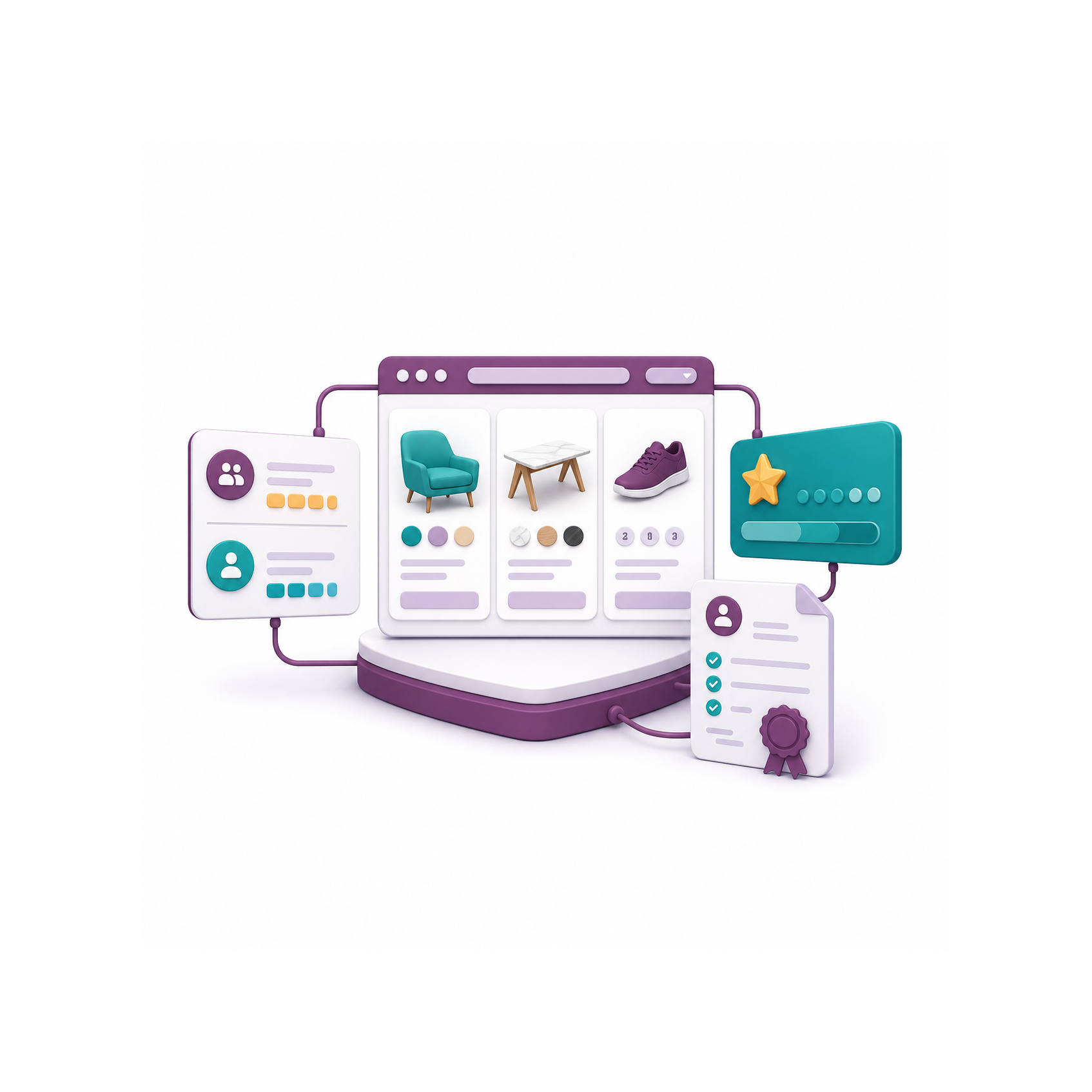
Product and variant records are shared across Sales, eCommerce, POS, Purchase, and Inventory. This centralizes the management of SKUs, barcodes, descriptions, images, and commercial settings.

B2B and B2C pricing

Separate price lists can be configured for different customer groups. Rules can account for currency, validity periods, quantities, and other conditions. Tax-inclusive or tax-exclusive price display should match the sales model and accounting configuration.

Tailored terms

Quotations for wholesale customers can specify agreed prices, discounts, quotation validity, payment terms, and expected delivery dates.

Discounts and loyalty

Odoo supports discounts and loyalty programs. The specific rules and program availability depend on the sales channel and installed configuration.


Inventory, delivery, and returns

Real-time stock levels

Inventory stores stock levels by warehouse and location. Product availability for sale depends on on-hand quantities, reservations, and expected stock movements.

Order picking

Orders can follow one-step or multistep warehouse workflows. Barcode helps employees scan products during receipts, transfers, picking, and delivery.

Purchasing and vendors

Purchase handles requests for quotation, purchase orders, and expected deliveries. Vendor prices and terms can be stored in product records.

Customer delivery

Customers can choose from configured delivery methods in the online store. Automatic rate calculation, shipping labels, and tracking numbers depend on the installed carrier module and available integration.

Product returns

A return is created from the original sale or delivery. It may generate a reverse stock transfer, a payment refund, and a credit note.

Return conditions, deadlines, and refund procedures should follow company policies and applicable law.

Odoo capabilities for eCommerce, retail, and wholesale

Answers to key questions about eCommerce, POS, wholesale, pricing, inventory, delivery, returns, and accounting.

Yes. Products and variants can be shared across eCommerce, Point of Sale, and Sales. Visibility, pricing, and assortment are configured for each channel.

Yes. Products can have attributes and variants. Each variant can have its own SKU, barcode, price, and stock balance.

Yes. Price lists apply different prices and calculation rules according to customer, currency, validity period, and quantity.

Yes. Register an inquiry as a lead or opportunity, move it through the pipeline, and create a quotation from it.

Yes. Inventory supports multiple warehouses and locations, and Point of Sale supports multiple POS configurations. Routes and delivery sources follow company settings.

Yes, with the appropriate product and inventory configuration. Online, POS, and wholesale orders can create or update related stock operations.

Yes. Replenishment rules can create purchasing or other supply requirements. The result depends on product routes and warehouse settings.

Yes. Returns can be initiated from completed deliveries. Refunds require additional payment and credit note processing.

Yes. Odoo supports multiple companies in one database. Multi-company is a system capability rather than a separate app.

Yes. Customer types can use separate sales teams, price lists, payment terms, order channels, and document processing rules.


Odoo capabilities for eCommerce, retail, and wholesale

Answers to key questions about eCommerce, POS, wholesale, pricing, inventory, delivery, returns, and accounting.


Yes. Products and variants can be shared across eCommerce, Point of Sale, and Sales. Visibility, pricing, and assortment are configured for each channel.

Yes. Products can have attributes and variants. Each variant can have its own SKU, barcode, price, and stock balance.

Yes. Price lists apply different prices and calculation rules according to customer, currency, validity period, and quantity.

Yes. Register an inquiry as a lead or opportunity, move it through the pipeline, and create a quotation from it.

Yes. Inventory supports multiple warehouses and locations, and Point of Sale supports multiple POS configurations. Routes and delivery sources follow company settings.

Yes, with the appropriate product and inventory configuration. Online, POS, and wholesale orders can create or update related stock operations.

Yes. Replenishment rules can create purchasing or other supply requirements. The result depends on product routes and warehouse settings.

Yes. Returns can be initiated from completed deliveries. Refunds require additional payment and credit note processing.

Yes. Odoo supports multiple companies in one database. Multi-company is a system capability rather than a separate app.

Yes. Customer types can use separate sales teams, price lists, payment terms, order channels, and document processing rules.


Which Odoo apps you will need

The solution scope depends on sales channels, warehouse count, and payment and delivery requirements. The core package connects the online store, retail locations, and wholesale sales with a shared catalog, inventory, purchasing, and financial documents, complemented by CRM, marketing, barcodes, and customer support


Core package

 Website — corporate websites and the foundation for online stores.

 eCommerce — catalogs, product pages, shopping carts, and online checkout.

 Sales — quotations, wholesale orders, and sales terms.

 Point of Sale — checkout and retail sales.

 Inventory — stock balances, warehouses, transfers, picking, and shipping.

  Purchase — procurement of goods and supplier management.

  Accounting or Invoicing — invoices, payments, and financial accounting.


Recommended apps

 CRM — inquiries, wholesale customers, and B2B sales pipelines.

 Barcode — warehouse operations using a scanner.

 Email Marketing — email campaigns for your customer base.

  Marketing Automation — automated marketing workflows.

  Live Chat — assistance for online store visitors.

  Helpdesk — customer inquiries and after-sales support.


Optional apps

  Manufacturing — production of private-label goods.

 Quality — inspections of incoming or manufactured goods.

 PLM — engineering change management for your own products.

    Sign — electronic signing of B2B documents.

   Studio — additional fields, models, and views for specialized processes.

Which Odoo apps you will need

The solution scope depends on sales channels, warehouse count, and payment and delivery requirements. The core package connects the online store, retail locations, and wholesale sales with a shared catalog, inventory, purchasing, and financial documents. Additional apps extend the system with CRM, marketing, barcodes, and customer support.


Core package

    Website — corporate websites and the foundation for online stores.

    eCommerce — catalogs, product pages, shopping carts, and online checkout.

    Sales — quotations, wholesale orders, and sales terms.

    Point of Sale — checkout and retail sales.

    Inventory — stock balances, warehouses, transfers, picking, and shipping.

    Purchase — procurement of goods and supplier management.

    Accounting or Invoicing — invoices, payments, and financial accounting.


Recommended apps

    CRM — inquiries, wholesale customers, and B2B sales pipelines.

    Barcode — warehouse operations using a scanner.

    Email Marketing — email campaigns for your customer base.

    Marketing Automation — automated marketing workflows.

   Live Chat — assistance for online store visitors.

    Helpdesk — customer inquiries and after-sales support.


Optional apps

    Manufacturing — production of private-label goods.

    Quality — inspections of incoming or manufactured goods.

    PLM — engineering change management for your own products.

    Sign — electronic signing of B2B documents.

 Studio — additional fields, models, and views for specialized processes.

Book an Odoo demo with an analyst today 

Discover how Odoo can help your business grow.

Request a demo

Book 

an Odoo demo with

an analyst today 

Discover how Odoo can help your business grow.

Request a demo