
↑
Skip to Content


For real estate and construction


Connect customers and contractors, construction projects, material purchasing, inventory, field service, rentals, and accounting in one system. Odoo manages CRM opportunities, tasks, stages, dependencies, deadlines, and project profitability, with purchases, materials, expenses, timesheets, and financial documents linked to projects.


Every project stage in one place.

​In real estate and construction, commercial, project, and financial processes are closely connected. Managers handle customers, project teams track deadlines, procurement buys materials, site teams deliver work, and accounting processes invoices and payments.

​When information is split between spreadsheets and programs, it is difficult to see deal stages, overdue work, material arrivals, and actual project profitability.

​Odoo unifies data in a shared system. CRM, projects, procurement, inventory, field service, and finance exchange information without repeated manual entry.

Every project stage in one place

In real estate and construction, commercial, project, and financial processes are closely connected. Managers handle customers, project teams track deadlines, procurement buys materials, site teams deliver work, and accounting processes invoices and payments.

When information is split between spreadsheets and programs, it is difficult to see deal stages, overdue work, material arrivals, and actual project profitability.

Odoo unifies data in a shared system. CRM, projects, procurement, inventory, field service, and finance exchange information without repeated manual entry.

Which processes Odoo supports

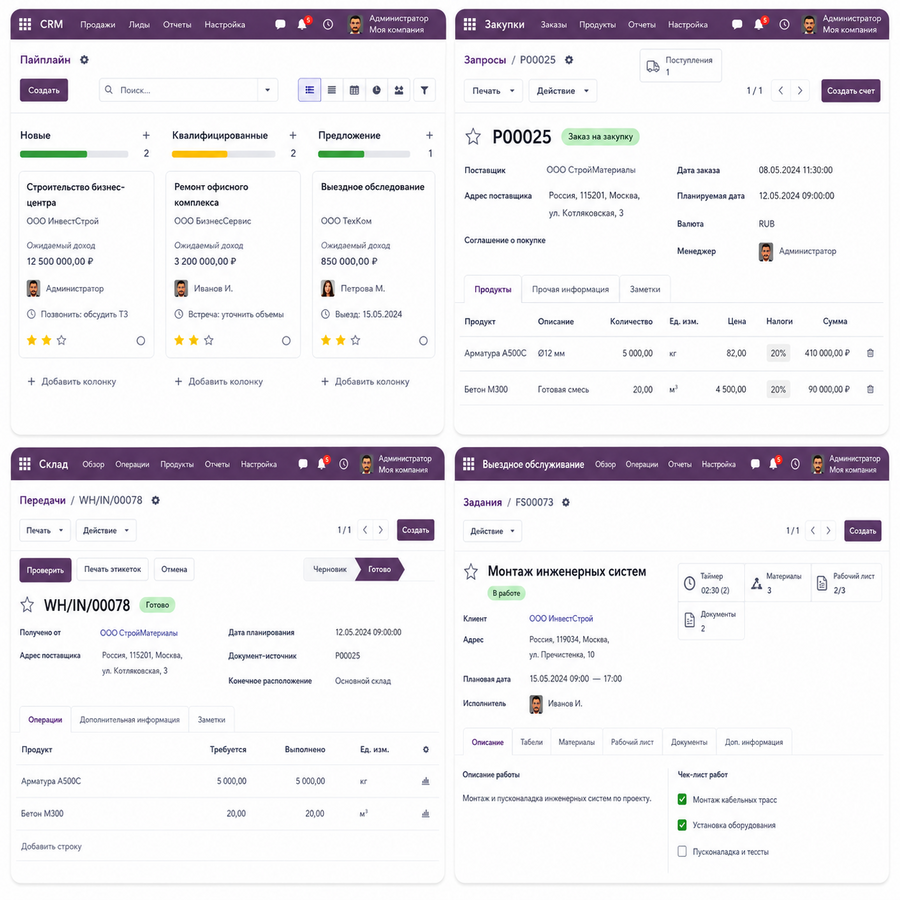
One system can manage customers and contractors, projects, purchasing, warehouse operations, field service, and accounting. Data flows between apps, connecting every stage from the first inquiry to work completion and profitability analysis.

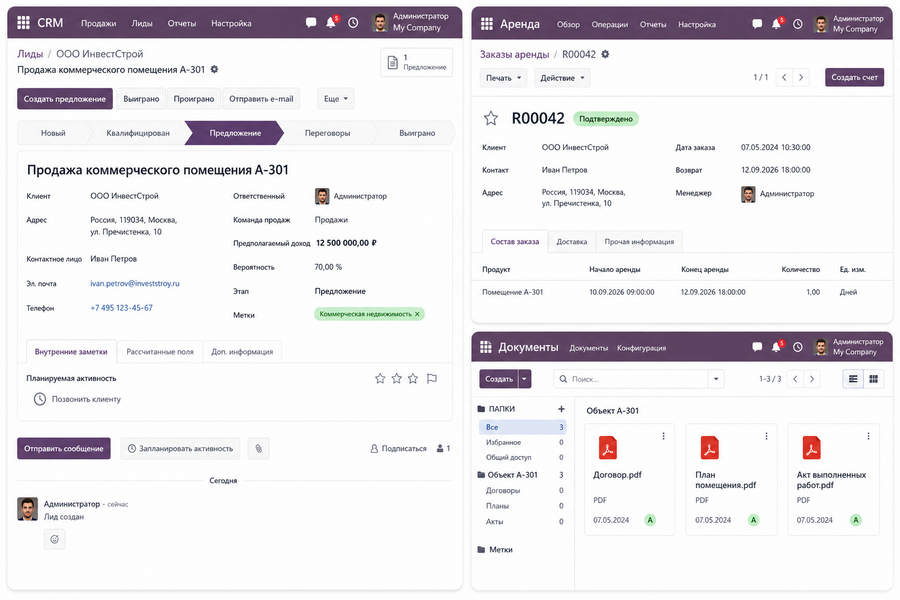
Record inquiries in CRM, assign salespeople, and move them through the pipeline. Set the customer, owner, expected revenue, probability, closing date, and next activities.

Salespeople can create quotations from opportunities, agree on terms with customers, and confirm orders.

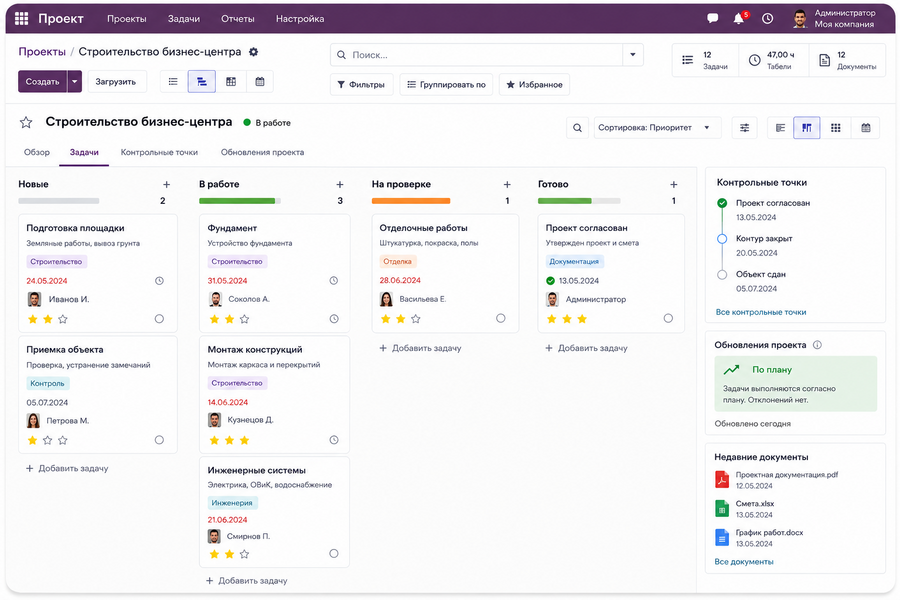
Create projects, stages, tasks, and subtasks. Assign owners, deadlines, and priorities, with descriptions, documents, and checklists.

Dependencies define work sequences, while milestones capture key outcomes and support phased invoicing.

Create RFQs and purchase orders in Purchase, recording the vendor, materials or services, prices, taxes, and planned delivery dates.

Once an order is confirmed, the system can create an expected receipt. Received goods are recorded in the warehouse, and the vendor bill is passed to accounting.

Inventory manages warehouses, locations, stock levels, receipts, internal transfers, and material issues.

Products can be tracked by lot or serial number. Barcode supports warehouse operations through mobile devices and scanners.

Field Service creates on-site tasks with the customer, address, assignee, and scheduled date.

Technicians can open tasks on mobile, read instructions, record time and materials, complete reports, and collect customer signatures.

Store contracts, drawings, estimates, instructions, acceptance records, and supporting files in Documents.

Documents can link to customers, opportunities, projects, and other records. Sign prepares documents and sends them to participants for electronic signature.

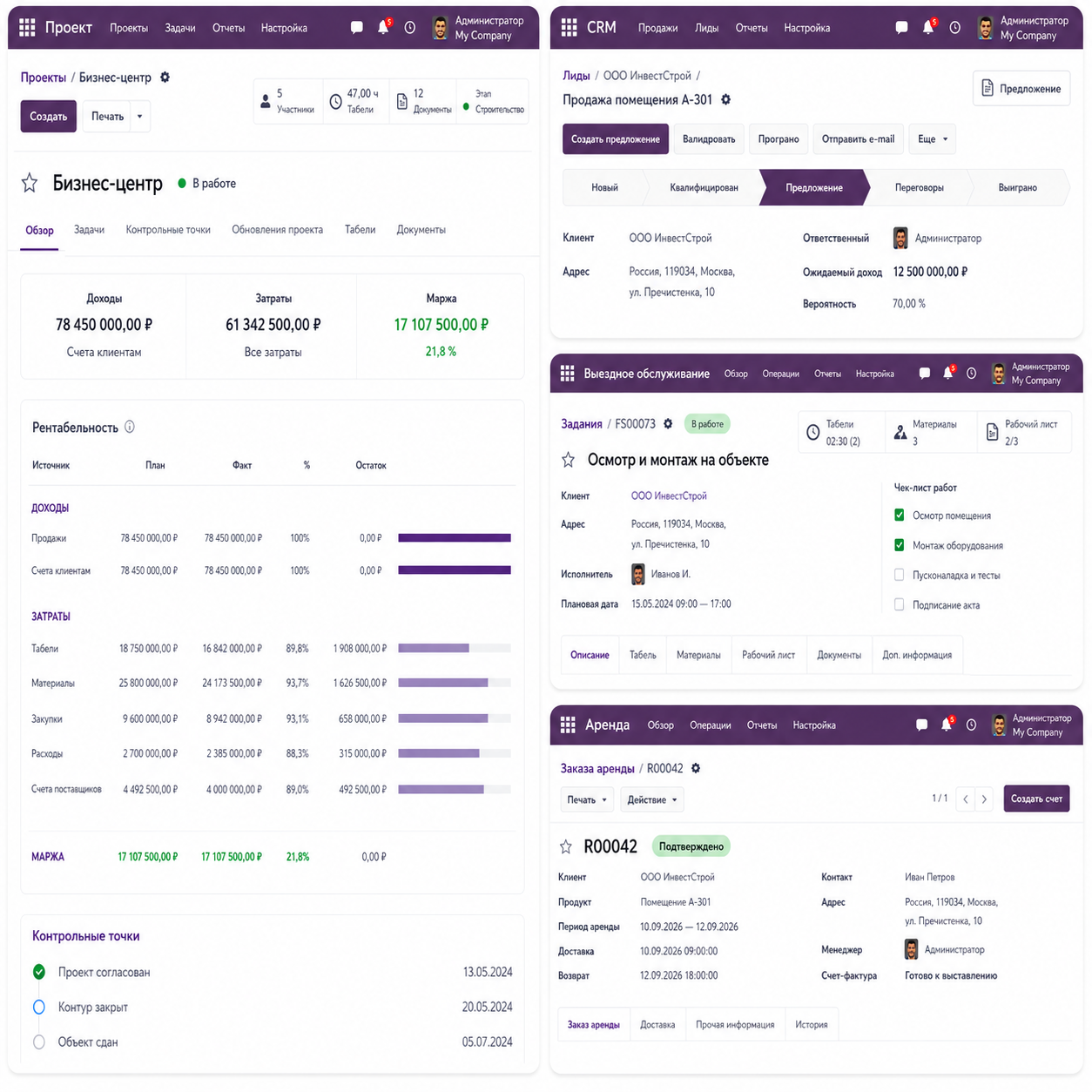
Sales, purchases, timesheets, expenses, and financial documents can link to a project and its analytic account.

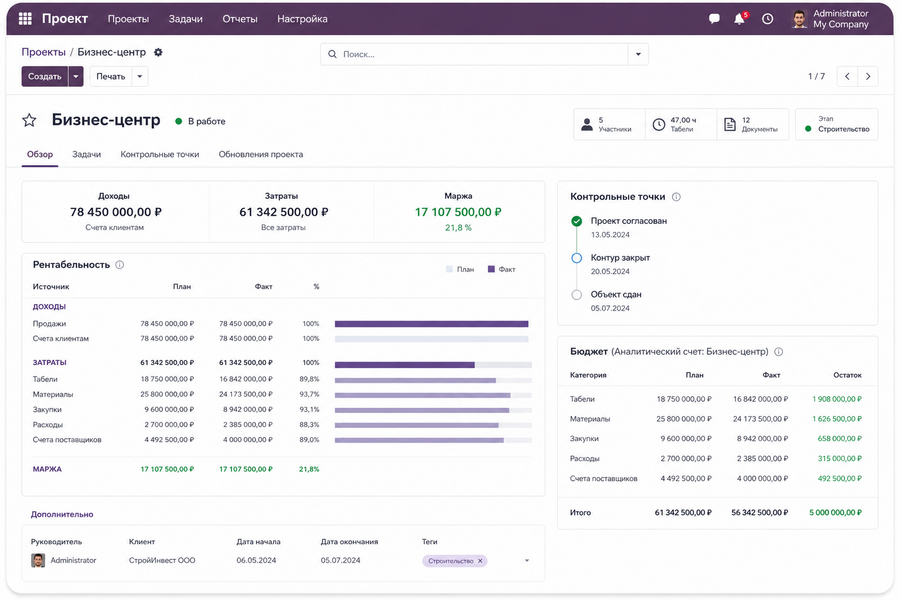
The profitability dashboard compares linked revenue and costs to assess project results. Calculation completeness depends on installed apps and analytic accounting configuration.

Rental supports the standard rental process: select the item and period, check availability, create the order, hand over the item, process the return, and invoice.

Long-term property rentals, indexation, deposits, utility charges, and lease management usually need additional configuration or an industry extension.


Which processes Odoo supports

One system can manage customers and contractors, projects, purchasing, warehouse operations, field service, and accounting. Data flows between apps, connecting every stage from the first inquiry to work completion and profitability analysis.


Record inquiries in CRM, assign salespeople, and move them through the pipeline. Set the customer, owner, expected revenue, probability, closing date, and next activities.

Salespeople can create quotations from opportunities, agree on terms with customers, and confirm orders.

Create projects, stages, tasks, and subtasks. Assign owners, deadlines, and priorities, with descriptions, documents, and checklists.

Dependencies define work sequences, while milestones capture key outcomes and support phased invoicing.

Create RFQs and purchase orders in Purchase, recording the vendor, materials or services, prices, taxes, and planned delivery dates.

Once an order is confirmed, the system can create an expected receipt. Received goods are recorded in the warehouse, and the vendor bill is passed to accounting.

Inventory manages warehouses, locations, stock levels, receipts, internal transfers, and material issues.

Products can be tracked by lot or serial number. Barcode supports warehouse operations through mobile devices and scanners.

Field Service creates on-site tasks with the customer, address, assignee, and scheduled date.

Technicians can open tasks on mobile, read instructions, record time and materials, complete reports, and collect customer signatures.

Store contracts, drawings, estimates, instructions, acceptance records, and supporting files in Documents.

Documents can link to customers, opportunities, projects, and other records. Sign prepares documents and sends them to participants for electronic signature.

Sales, purchases, timesheets, expenses, and financial documents can link to a project and its analytic account.

The profitability dashboard compares linked revenue and costs to assess project results. Calculation completeness depends on installed apps and analytic accounting configuration.

Rental supports the standard rental process: select the item and period, check availability, create the order, hand over the item, process the return, and invoice.

Long-term property rentals, indexation, deposits, utility charges, and lease management usually need additional configuration or an industry extension.


Every stage is connected

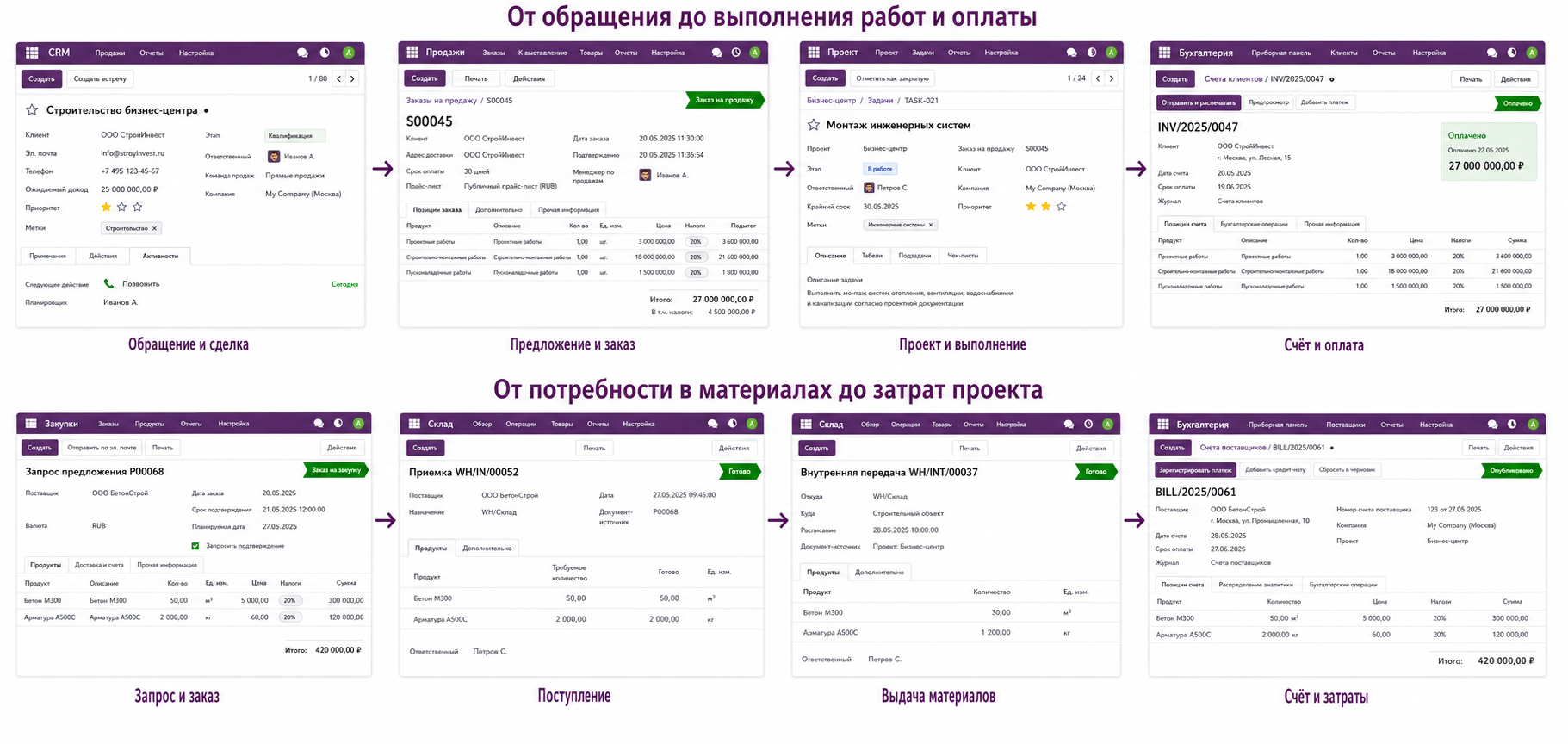
Odoo combines sales, project, inventory, and financial operations into end-to-end processes. Data flows from one stage to the next, from the customer inquiry through delivery, payment, and cost accounting.

Every stage is connected

Odoo combines sales, project, inventory, and financial operations into end-to-end processes. Data flows from one stage to the next, from the customer inquiry through delivery, payment, and cost accounting.


 From request to payment


Depending on configuration, an order can create a project with tasks. Assignees record time, materials, and results, then invoices follow the agreed model: fixed price, actual time spent, or completed milestones.

 From purchasing to retirement


Materials are ordered through RFQs and purchase orders. Received goods are stocked and transferred to the required site.

Projects, deadlines, and profitability

Plan tasks and milestones, record time and expenses, and compare targets with actual results.

Break projects into stages, tasks, and subtasks with assignees, deadlines, priorities, and dependencies.

Tasks appear in Kanban, list, calendar, or Gantt views, depending on installed apps and available views.

Milestones identify key project outcomes, such as documentation approval, construction phase completion, work acceptance, or property handover.

With the right configuration, reaching a milestone can trigger the next customer invoice.

Employees record project and task time in Timesheets. Expenses handles travel and transport, while Purchase, Inventory, and Accounting cover materials and services.

This captures actual effort and expenses alongside planned figures.

Analytic accounts group revenue and costs by project, property, or business area.

With budget management enabled, compare targets with actual revenue and expenses.

The project profitability dashboard combines linked sales and operational data. Calculations can include sales orders, invoices, timesheets, expenses, purchases, and consumed material costs.

For accurate results, all relevant operations must be consistently linked to the project and its analytic account.


Projects, deadlines, and profitability

Plan tasks and milestones, record time and expenses, and compare targets with actual results.


Break projects into stages, tasks, and subtasks with assignees, deadlines, priorities, and dependencies.

Tasks appear in Kanban, list, calendar, or Gantt views, depending on installed apps and available views.

Milestones identify key project outcomes, such as documentation approval, construction phase completion, work acceptance, or property handover.

With the right configuration, reaching a milestone can trigger the next customer invoice.

Employees record project and task time in Timesheets. Expenses handles travel and transport, while Purchase, Inventory, and Accounting cover materials and services.

This captures actual effort and expenses alongside planned figures.

Analytic accounts group revenue and costs by project, property, or business area.

With budget management enabled, compare targets with actual revenue and expenses.

The project profitability dashboard combines linked sales and operational data. Calculations can include sales orders, invoices, timesheets, expenses, purchases, and consumed material costs.

For accurate results, all relevant operations must be consistently linked to the project and its analytic account.


Sales, rentals, and property management

Odoo connects opportunities, orders, projects, and documents in a single customer history. Standard rentals are managed in Rental, while specialized property tracking is configured separately.

CRM can manage opportunities for property sales, rentals, construction, and related services.

Opportunity records store the customer, assigned salesperson, communication history, planned activities, quotations, and attachments.

Once terms are agreed, the salesperson confirms the order. Depending on configuration, this creates projects, tasks, or field service jobs.

Invoice fixed prices, milestones, actual time, or delivered materials.

Standard Rental suits equipment, tools, and other tracked rental items, with rental periods, availability checks, handover, returns, and invoicing.

Using Rental for long-term space rentals requires process analysis and usually additional configuration.

Standard Odoo does not include a universal app for comprehensive property management.

A basic register of properties, buildings, units, and land plots can be created with additional models and fields. Availability grids, space booking, rent indexation, deposits, utility charges, and BIM or CAD integrations require configuration, industry modules, or external integrations.

Sales, rentals, and property management

Odoo connects opportunities, orders, projects, and documents in a single customer history. Standard rentals are managed in Rental, while specialized property tracking is configured separately.


CRM can manage opportunities for property sales, rentals, construction, and related services.

Opportunity records store the customer, assigned salesperson, communication history, planned activities, quotations, and attachments.

Once terms are agreed, the salesperson confirms the order. Depending on configuration, this creates projects, tasks, or field service jobs.

Invoice fixed prices, milestones, actual time, or delivered materials.

Standard Rental suits equipment, tools, and other tracked rental items, with rental periods, availability checks, handover, returns, and invoicing.

Using Rental for long-term space rentals requires process analysis and usually additional configuration.

Standard Odoo does not include a universal app for comprehensive property management.

A basic register of properties, buildings, units, and land plots can be created with additional models and fields. Availability grids, space booking, rent indexation, deposits, utility charges, and BIM or CAD integrations require configuration, industry modules, or external integrations.


Odoo capabilities for real estate and construction

Brief answers about sales, deadlines, contractors, materials, costs, field work, and rentals.

Yes. CRM supports separate teams, pipelines, and stages for different opportunity types, with assigned salespeople, planned activities, and quotations.

Yes. Project supports tasks, subtasks, deadlines, owners, dependencies, and milestones. Overdue and blocked tasks can be tracked in operational views and reports.

Yes. Contractor services can be ordered through Purchase. The system records the vendor, service description, cost, deadlines, and related financial documents.

Yes, with the appropriate inventory and analytic configuration. Purchases, material issues, and vendor bills can be linked to a project or its analytic account.

Yes. Employees record time against projects and tasks in Timesheets. This supports effort analysis, profitability calculations, and invoicing when required.

Yes, with analytic accounting and budget management configured. Compare targets with actual revenue and expenses by project or business area.

Yes. Field Service creates tasks, assigns technicians, schedules dates, and records time, materials, outcomes, and customer signatures.

Standard Rental manages ordinary item rentals. Long-term property contracts, deposits, indexation, and utility billing require configuration or an industry solution.


Odoo capabilities for real estate and construction

Brief answers about sales, deadlines, contractors, materials, costs, field work, and rentals.


Yes. CRM supports separate teams, pipelines, and stages for different opportunity types, with assigned salespeople, planned activities, and quotations.

Yes. Project supports tasks, subtasks, deadlines, owners, dependencies, and milestones. Overdue and blocked tasks can be tracked in operational views and reports.

Order contractor services through Purchase. The system records vendors, descriptions, costs, deadlines, and related financial documents.

Yes, with the appropriate inventory and analytic configuration. Purchases, material issues, and vendor bills can be linked to a project or its analytic account.

Yes. Employees record time against projects and tasks in Timesheets. This supports effort analysis, profitability calculations, and invoicing when required.

Yes, with analytic accounting and budget management configured. Compare targets with actual revenue and expenses by project or business area.

Yes. Field Service creates tasks, assigns technicians, schedules dates, and records time, materials, outcomes, and customer signatures.

Standard Rental manages ordinary item rentals. Long-term property contracts, deposits, indexation, and utility billing require configuration or an industry solution.

Which Odoo apps you will need

The app selection depends on your company's processes. Below is the core, recommended, and optional solution scope.


Core package

    CRM — inquiries, opportunities, and sales pipelines.

    Sales — quotations, orders, and sales terms.

    Project — projects, stages, tasks, and dependencies.

    Timesheets — working time records.

    Purchase — procurement of materials and contractor services.

    Inventory — warehouses, materials, and stock movements.

    Accounting or Invoicing — invoices, payments, and financial accounting.


Recommended apps

    Planning — employee and resource scheduling.

    Field Service — on-site work and materials used.

    Expenses — employee travel and other expenses.

    Documents — storage for contracts, drawings, and acceptance documents.

    Sign — electronic document signing.

    Approvals — internal approval of requests and expenses.

    Barcode — warehouse operations with a scanner.


Optional apps

    Rental — standard rental orders and return tracking.

    Maintenance — servicing construction and technical equipment.

    Helpdesk — warranty and service inquiries.

    Website — corporate websites and publishing property pages.

   Studio or industry modules — specialized property and construction process management..

Book 

an Odoo demo with

an analyst today 

Discover how Odoo can help your business grow.

Request a demo

Which Odoo apps you will need

The app selection depends on your company's processes. Below is the core, recommended, and optional solution scope.


Core package

    CRM — inquiries, opportunities, and sales pipelines.

    Sales — quotations, orders, and sales terms.

    Project — projects, stages, tasks, and dependencies.

    Timesheets — working time records.

    Purchase — procurement of materials and contractor services.

    Inventory — warehouses, materials, and stock movements.

    Accounting or Invoicing — invoices, payments, and financial accounting.


Recommended apps

    Planning — employee and resource scheduling.

    Field Service — on-site work and materials used.

    Expenses — employee travel and other expenses.

    Documents — storage for contracts, drawings, and acceptance documents.

    Sign — electronic document signing.

    Approvals — internal approval of requests and expenses.

    Barcode — warehouse operations with a scanner.


Optional apps

    Rental — standard rental orders and return tracking.

    Maintenance — servicing construction and technical equipment.

    Helpdesk — warranty and service inquiries.

    Website — corporate websites and publishing property pages.

   Studio or industry modules — specialized property and construction process management..

Book an Odoo demo with an analyst today 

Discover how Odoo can help your business grow.

Request a demo